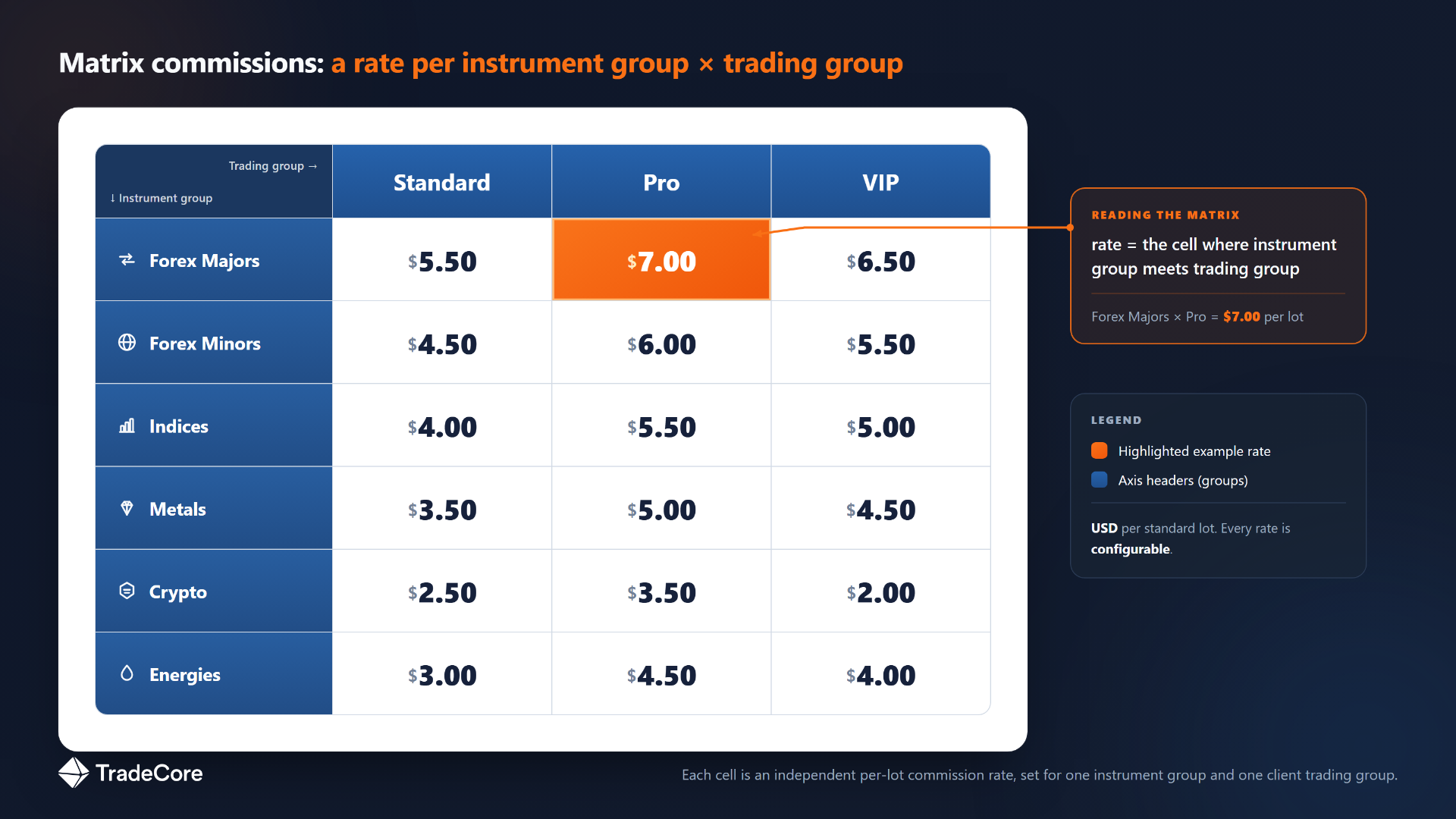
Matrix commissions in a forex IB (Introducing Broker) system are a two-dimensional commission table where one axis is the instrument group (Forex Majors, Forex Minors, Indices, Crypto, Metals, Energies, and others) and the other axis is the client trading group (Standard, Pro, VIP, regional groups, or whatever segmentation the broker runs). Each cell in the matrix holds a configurable commission rate, paid to the partner on every closed trade that falls into that cell. The rate the partner earns on a specific trade is the rate in the cell at the intersection of the instrument's group and the trading account's group.
Matrix is not a separate kind of commission. It is one of two configuration modes for a trade-based commission rule. In Simple mode, a trade-based rule pays the partner one flat rate across every trade. In Matrix mode, the same rule pays a separate rate per instrument category per client segment, so the broker can pay more for desirable flow (Forex Majors on Standard accounts) and less for less desirable flow (Crypto on VIP accounts, or whatever the broker's risk profile dictates), down to each individual partner.
Why do brokers use matrix commissions?
Three reasons drive brokers to matrix mode on at least some of their IB programs.
- Pricing per asset class. A broker's profitability on Forex Majors is different from their profitability on Crypto, which is different again from Indices. A single flat rate either overpays partners on low-margin flow or underpays them on high-margin flow. A matrix lets the broker pay a rate that reflects the broker's actual margin per cell, not a blended approximation.
- Pricing per client segment. A VIP client trading 100 lots of Forex Majors a day generates different unit margin than a Standard client trading 1 lot of Crypto a day. A matrix gives the partner one rate for the first kind of flow and a different rate for the second, on the same partner record.
- Negotiating leverage with partners. Top-tier partners often concentrate their flow in specific instruments or segments. A matrix lets the broker negotiate a higher rate in the cells the partner actually fills (say, EUR Forex Majors on Pro accounts) without raising the partner's rate across the whole book. The partner gets a strong rate on the volume they bring, and the broker is not exposed on volume they did not bring.
Brokers without a matrix option either compress all this nuance into a single flat rate and accept the margin leak, or run multiple partner records per partner to simulate per-cell pricing, which is operationally messy.
Is matrix a separate commission type, or part of trade-based commissions?
Matrix is part of trade-based commissions. It is not a fourth commission type sitting next to the others. BrokerIQ's commission engine has three top-level commission types, and trade base and CPA each break down into subcomponents.
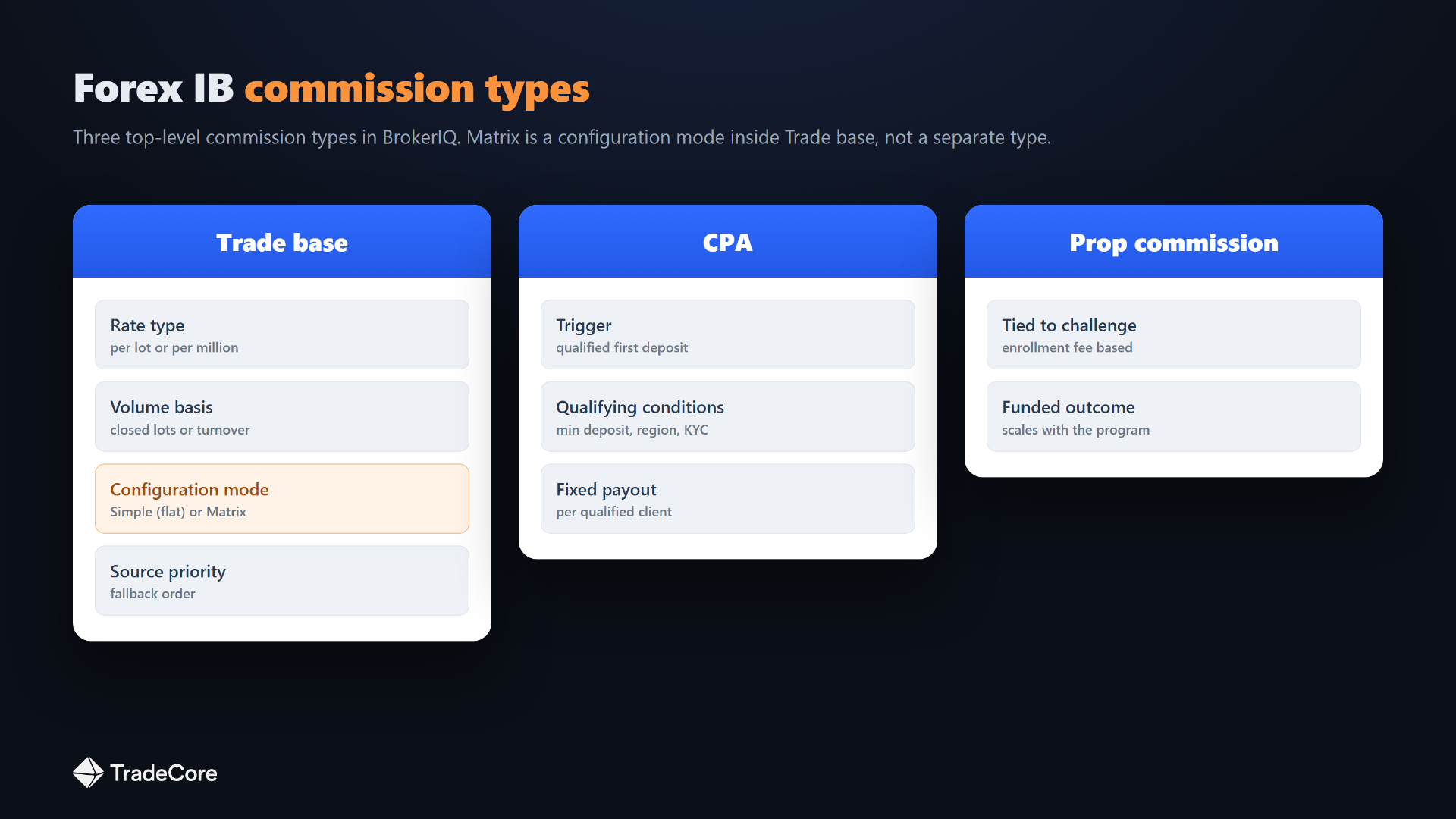
Illustrative breakdown of the three top-level commission types, trade base, CPA, and prop commission, with matrix sitting inside trade base as a configuration mode. Illustrative diagram, not a screenshot of the live BrokerIQ product.
1. Trade base (trade-based commissions). Earned on a referred client's trading activity and calculated automatically on every trade close. A trade-based rule is configured along these axes:
- Rate type: per-lot, Spread Share Value (SSV), or both.
- Volume basis: per lot, or per $100K notional.
- Configuration mode: Simple (one flat rate) or Matrix (a rate that varies by instrument group and trading group). This is where matrix lives.
- Source priority: Instrument Group, then Trading Group, then Account Type, then Default.
2. CPA (cost per acquisition). A fixed amount paid when a referred client meets a configured condition. Its subcomponents:
- Trigger: first deposit, first trade, or both.
- Conditions: minimum deposit amount, minimum lots traded.
- Payout: fixed amount per qualified client, deduplicated to one per partner-client pair.
3. Prop commission (prop challenge commissions). Paid on every prop challenge enrollment purchase, as a fixed amount, a percentage of the challenge price, or both. No deduplication, so partners earn on every sale.
So "flat per-lot" and "matrix" are not two different commission types. They are two configuration modes of the same trade-based rule: flat per-lot is Simple mode with a per-lot rate, and matrix is the same rule with a per-cell rate. A partner can also combine trade base and CPA in a single rule (the hybrid partner type), and all three top-level types can run side by side on the same network.
What is the source-priority hierarchy in a matrix?
Matrix rates resolve by source priority, from most specific to least specific:
- Instrument Group override. Most specific. If a cell exists at the intersection of this instrument group and this trading group, the rate from the matrix wins.
- Trading Group override. Less specific. If no instrument-group cell matches but a trading-group default exists for the partner, that rate applies.
- Account Type override. Even less specific. If neither of the above matches, the rate falls back to the partner's account-type-level rate.
- Default. The partner's base flat rate.
The hierarchy matters because it lets brokers run a global flat rate (Default) with selective matrix overrides on the cells where precise pricing is worth it. A broker does not need to fill in every cell to use a matrix. They fill in the cells that matter and let the rest fall back to the default.
When should a broker use matrix mode vs a simple flat rate?
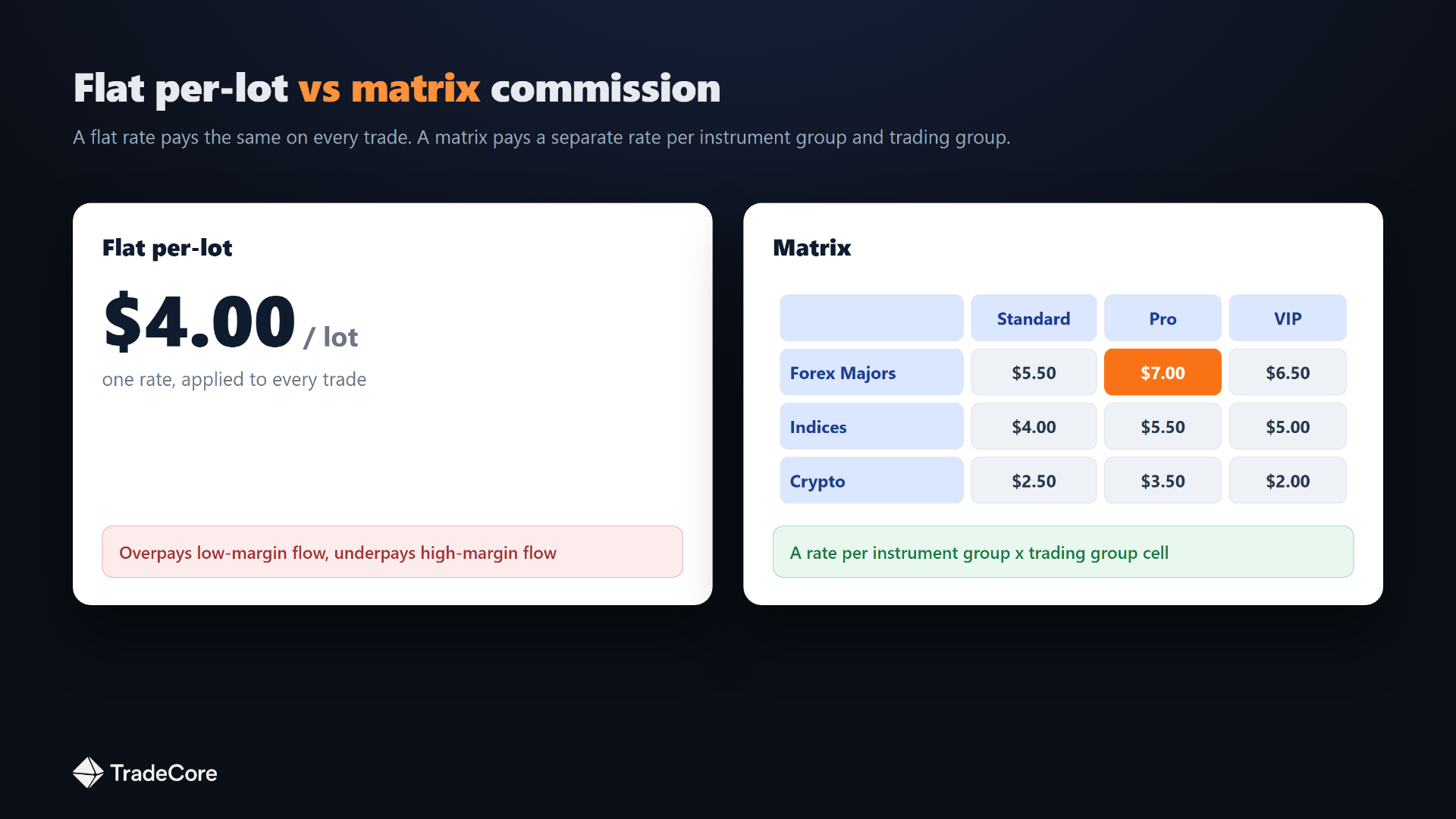
Illustrative comparison of matrix mode against a simple flat per-lot rate: one rate for every trade versus a per-cell rate by instrument group and trading group. Illustrative diagram, not a screenshot of the live BrokerIQ product.
| Partner or flow profile | Recommended setup |
|---|---|
| Long-tail partners, low volume each | Trade base in Simple mode (one flat per-lot rate) |
| Acquisition agencies, comparison sites | CPA |
| Partners who refer and drive activity | Trade base plus CPA (the hybrid partner type) |
| Top partners with flow concentrated in specific instruments or segments | Trade base in Matrix mode |
| Regional networks with segment-specific economics | Trade base in Matrix mode |
| Books where broker margin varies widely by instrument | Trade base in Matrix mode |
Long-tail partners, low volume each
- Recommended setup
- Trade base in Simple mode (one flat per-lot rate)
Acquisition agencies, comparison sites
- Recommended setup
- CPA
Partners who refer and drive activity
- Recommended setup
- Trade base plus CPA (the hybrid partner type)
Top partners with flow concentrated in specific instruments or segments
- Recommended setup
- Trade base in Matrix mode
Regional networks with segment-specific economics
- Recommended setup
- Trade base in Matrix mode
Books where broker margin varies widely by instrument
- Recommended setup
- Trade base in Matrix mode
A matrix takes more thought than a single flat rate, but in BrokerIQ it does not mean heavy manual overhead. A commission rule is defined once and assigned to as many IBs as you like, so a matrix you build for one partner can cover an entire segment in a few clicks. Any existing rule can be copied and modified, so you start from a working matrix instead of a blank grid. Overrides let you adjust individual cells or levels without rebuilding the rule. And because rates resolve by source priority, you only fill the cells that matter and let the rest fall back to the default. The result is that per-cell precision does not come with per-partner manual work. The wrong reason to use matrix is "we should have one big table for everyone." The right reason is "this partner's flow is concentrated in specific cells and I want to price each cell on its actual margin."
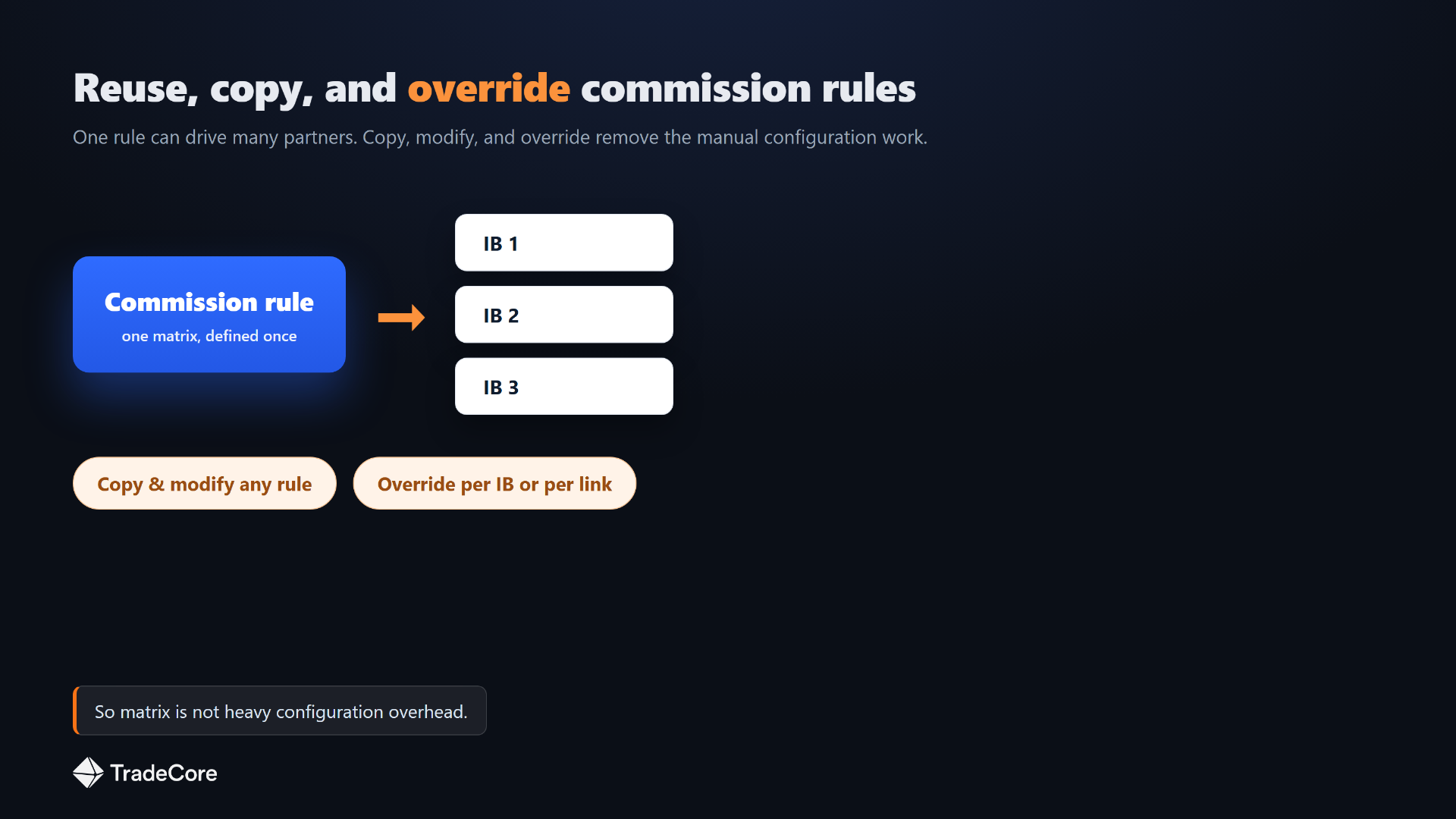
Illustrative view of how one commission rule is reused across many IBs, copied and modified, and refined with overrides, so per-cell precision does not become per-partner manual work. Illustrative diagram, not a screenshot of the live BrokerIQ product.
Does TradeCore support matrix commissions?
Yes. In the BrokerIQ IB system, matrix is one of two configuration modes (Simple or Matrix) for a trade-based commission rule. A matrix is two-axis (instrument group on one axis, trading group on the other) with a configurable rate per cell, and rates resolve by source priority: Instrument Group, then Trading Group, then Account Type, then Default. Trade-based rules, in either mode, run alongside CPA and prop-challenge commissions on the same partner network and inside an unlimited-tier IB hierarchy. A broker can pay a flat per-lot rate to the long tail, CPA to acquisition partners, and a matrix to the top tier, all from one commission engine. Because any rule can be assigned to many IBs, copied and modified, and adjusted with overrides, running a matrix across a large network does not require per-partner manual setup.
For the wider IB-system context, see the pillar piece Eight IB-System Features Most Forex CRMs Do Not Have and take the Partner Hub self-service portal tour. You can also explore the BrokerIQ partner platform and review pricing. To see matrix configuration set up on your own instrument and trading groups, talk to the TradeCore team.
Frequently asked questions
Tags
Ready to Get Started?
Discover how TradeCore can help you build and scale your forex brokerage with our comprehensive CRM.