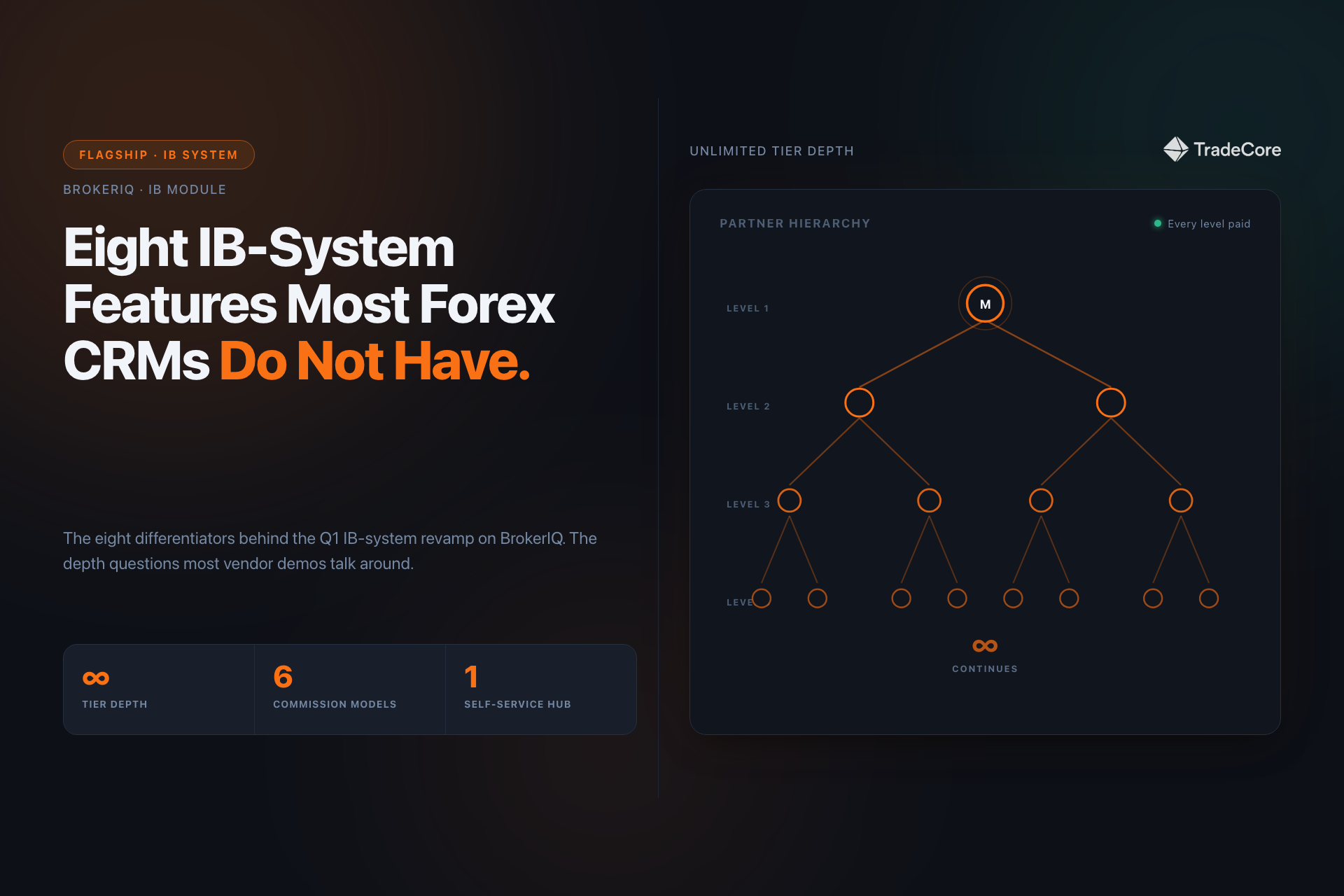
An IB program is a product, not a feature. The brokers that scale through partners do not have better luck; they have a partner system that pays on time, tracks every click and every lot, lets ops suspend a single bad actor without halting the rest of the network, and gives partners a self-service portal they actually use. Most forex CRMs in the category cover the surface of this and leave the operating depth out. This post lists the eight IB-system capabilities that separate the platforms a serious partner channel can run on from the ones that pass the demo and fail the third month.
The capabilities below are the eight differentiators behind the Q1 IB-system revamp on BrokerIQ. Every claim is grounded in the platform's IB module as it ships today.
1. Unlimited IB tier depth (most platforms cap at 3 to 5)
Most forex CRMs in the category cap their IB hierarchy at three or five levels. Past the cap, the system stops paying upline partners, and the broker pays the tail manually or loses the network. BrokerIQ has no level cap. A Master IB can have sub-IBs, those sub-IBs can have sub-sub-IBs, and the system tracks attribution and pays commissions at every level continuously.
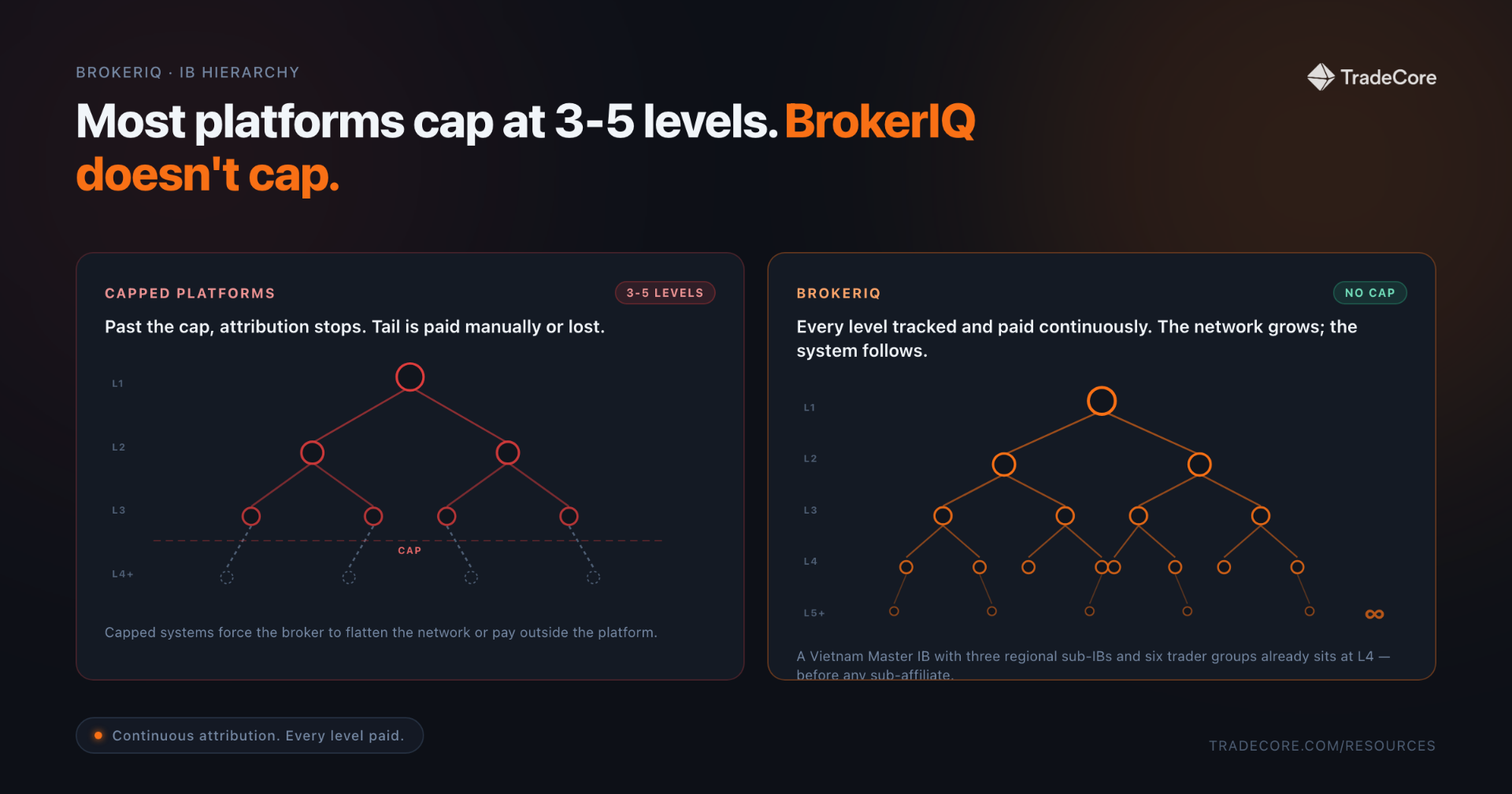
Capped vs uncapped IB hierarchy — BrokerIQ doesn't cap tier depth.
The mechanic matters because regional networks rarely fit a fixed depth. A Master IB in Vietnam who runs three regional sub-IBs who each run six trader groups is already at level four, before any sub-affiliate adds depth on the consumer end. A capped system forces the broker to flatten or pay outside the platform; an uncapped system grows with the network.
Evaluate: ask the vendor for the maximum tier depth, in writing. "Unlimited" should mean unlimited.
2. Per-lot, CPA, hybrid, matrix, spread share, and Prop challenge commission models in one engine
Most forex CRMs in the category support one or two commission models, usually per-lot only, or per-lot plus a flat CPA. BrokerIQ supports six, side by side, and a partner can have rules combining them:
- Per lot: commission per closed-trade lot, configurable per instrument group and per client group. A 5-lot EURUSD trade at $2/lot Forex Majors and the partner earns $10.
- CPA (cost per acquisition): a fixed amount paid when a referred client meets a condition, usually first deposit at or above a configured minimum. Deduplicated so the same client triggers the CPA once per partner.
- Hybrid: CPA on acquisition plus per-lot on every subsequent trade. The two rules coexist on the same partner.
- Matrix: a two-axis table with instrument group on one axis and trading group on the other, rate per cell. Used by brokers with complex books to set surgical per-cell pricing.
- Spread share: a configurable share of the broker's spread paid to the partner as commission, calculated per trade. Used when the broker prefers to share top-of-book revenue rather than pay a fixed per-lot rate.
- Prop challenge: commission paid on prop-challenge sales referred by the partner. Used by brokers running a prop program alongside the live brokerage.
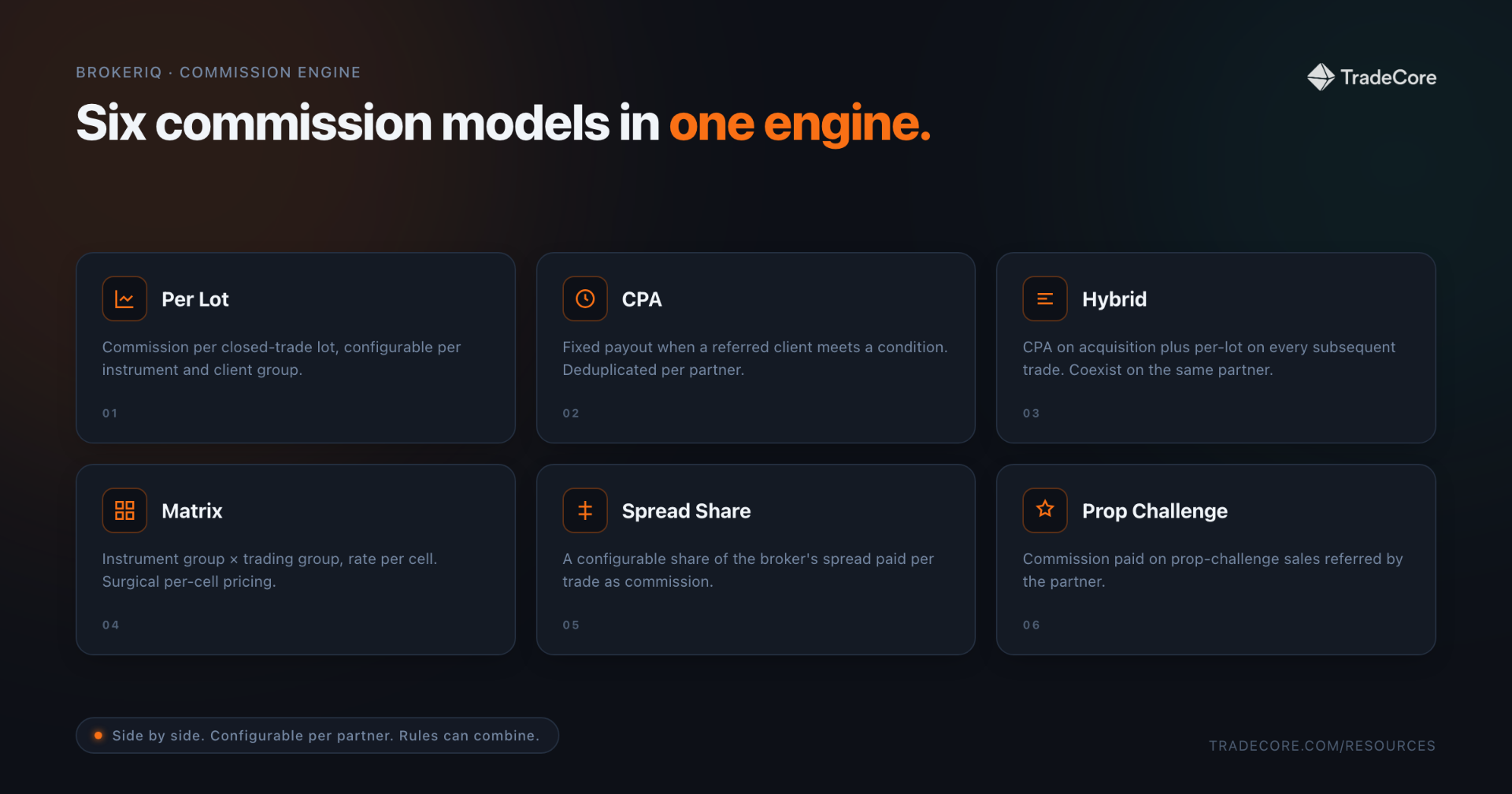
Six commission models in BrokerIQ's commission engine — Per Lot, CPA, Hybrid, Matrix, Spread Share, Prop Challenge.
The Commission Engine checks rules in order from most specific to least specific and applies the first match. Ops can model the commercials they actually need, instead of forcing the network into the model the platform allows.
Evaluate: ask the vendor whether per-lot, CPA, hybrid, matrix, spread share, and Prop challenge commissions can run side by side on the same network. Many platforms answer "yes" until you ask to see all six configured at once.
3. Master IB mode and Broker mode in the same hierarchy
The next capability most forex CRMs in the category skip is the control mode. Two real-world IB structures exist and they are not the same product:
- Master IB mode: the Master IB controls the money downstream. The commission generates at the Master, who splits with sub-IBs at percentages agreed between them. Used when a Master brings their own network and wants to run it. Master IB mode itself has two sub-options.
- Broker mode: each sub-IB is paid directly by the broker, and the Master earns an independent override on top. The broker decides each level's rate; the Master does not control the sub-IB payouts.
BrokerIQ supports both, configurable per partner program. A broker can run a Master IB mode network in one region and a Broker mode network in another without rebuilding the hierarchy. The platforms that skip this either force every Master to manage their downstream (which alienates broker-controlled networks) or pay every level independently (which alienates Master IBs running their own teams).
Evaluate: ask which mode the platform supports, whether both can run in parallel, and which Master IB sub-modes are available.
4. Auto-tier promotion with retention thresholds and grace periods
Tier programs (Bronze, Silver, Gold, Platinum) are common on the marketing slide and rare on the demo screen. Most forex CRMs in the category either skip tiers entirely or implement them as a manual ops chore: a spreadsheet of conditions, a person who reviews monthly, and a partner who finds out about their promotion a week late.
BrokerIQ evaluates tier eligibility daily. Promotion conditions are configurable (active client count, total deposits, lots traded, or combinations). Retention thresholds are configurable (the minimum activity to stay in the tier). Grace periods are configurable (how long an underperforming partner has to recover before they drop). When a partner crosses a promotion threshold, the system promotes; when they fall below retention and the grace period expires, the system drops. No ops involvement, no spreadsheet, no missed month.
The capability does two things at once: it removes a manual ops job, and it gives partners a real-time leaderboard mechanic that drives competitive behaviour in the network.
Evaluate: ask whether tier evaluation is automated on a schedule, and whether retention and grace are first-class settings or after-thought workarounds.
5. Branded Partner Hub: a self-service portal partners actually use
An IB program without a partner-side portal is an IB program where every commission question, every link request, every withdrawal becomes an ops ticket. Most forex CRMs in the category either skip the partner portal or ship one branded by the vendor (the partner logs into someone-else.com to see their commissions, which is a brand leak no broker wants).
BrokerIQ's Partner Hub is the partner-side portal, fully branded to the broker (logo, colours, custom domain). From the Hub, a partner can:
- See earnings, active clients, and trading volume at a glance.
- Browse referred clients and their deposit/trade history.
- Check commission history filterable by date or type.
- Create and manage their own tracking links.
- If they are a Master IB, manage their sub-IB network and set split percentages.
- See their full network tree, every level visualised.
- Download marketing materials the broker has uploaded.
- Request a withdrawal of accumulated commissions.
Every action above is a ticket the broker's ops team no longer answers. The economics are linear: the more a partner can self-serve, the more partners a single ops headcount can support.
Evaluate: ask whether the partner portal is broker-branded with a custom domain, and which actions are self-service versus ops-mediated.
6. Per-channel tracking links with independent commission rates
Most forex CRMs in the category give each IB one tracking link. The IB pastes the same link into a Facebook campaign, a website banner, and a Telegram group, and the broker has no way to tell which channel produced which client. The IB cannot run channel-level economics either, because every channel pays the same rate.
BrokerIQ lets a single IB create multiple tracking links, each with its own slug, its own attribution, and its own commission rule. The IB can run a $3/lot link for their high-effort YouTube channel and a $1.50/lot link for a low-effort banner campaign, all under the same partner record. Click-through metadata (country, device, browser) is tracked per link, so the partner sees channel-level performance and the broker sees the same data on the back-office side.
The capability turns a tracking link from a single URL into a channel attribution system the partner runs themselves.
Evaluate: ask whether a single IB can have multiple tracking links, and whether each link can have its own commission rule.
7. Per-partner payout approval with selective partner suspend
Payouts are where unified IB systems separate from spreadsheet-grade ones, and most forex CRMs in the category cut corners here in one of two ways: either every payout goes through a single approve-all gate (which means ops cannot hold one partner without delaying everyone), or payouts run automatically with no approval gate at all (which means a fraud incident becomes a clawback exercise).
BrokerIQ runs a Pending to Approved to Paid workflow per partner per cycle. Ops can approve, reject, or hold any single partner's payout without affecting any other partner in the same cycle. If one partner shows suspicious activity, ops can Suspend that partner — every other partner in the cycle is still paid on time. Suspend revokes the partner's access to the self-service Partner Hub until ops lifts it.
The capability is the operational difference between "we discovered the bad actor and paused everyone for a week" and "we discovered the bad actor and suspended them in 30 seconds."
Evaluate: ask whether payouts can be approved per partner versus per cycle, and whether a partner can be suspended individually without holding the rest of the cycle.
8. Instant payouts for trusted partners
Cycle-based payouts are the standard model: commissions accumulate, the cycle ends, ops approve, money moves. It is correct for most partners and wrong for the top tier of any mature network. A high-volume Master IB does not want to wait 14 days for a $40,000 commission to clear; that is the kind of friction that drives the best partners off a platform.
BrokerIQ supports instant payouts per rule, configurable at the partner level. A trusted partner can have their per-lot commissions credited to their wallet immediately on trade close, available for withdrawal without waiting for a cycle. Cycle-based payouts continue to run for the rest of the network in parallel. The two models coexist and ops decide per partner.
Instant payouts are an upgrade lever for the network: the partners who earn it get it, which is itself a retention mechanism.
Evaluate: ask whether instant payouts are supported per partner alongside cycle-based payouts.
How to use this list at a vendor meeting
Three of the eight (unlimited tier depth, the six commission models, the Partner Hub branding) are surface-level questions any vendor should answer in 30 seconds. The other five (mode parity, auto-tier with grace, per-channel links, selective suspend, instant payouts) are the depth questions, and they are where most vendor demos pivot to talking about "the roadmap" instead of the product.
If the vendor cannot demonstrate all eight on a live platform inside a 20-minute meeting, the IB system is the marketing surface, not the operating surface. Both kinds of platform exist. Only one of them runs a serious partner channel without consuming an operations analyst per a few hundred partners.
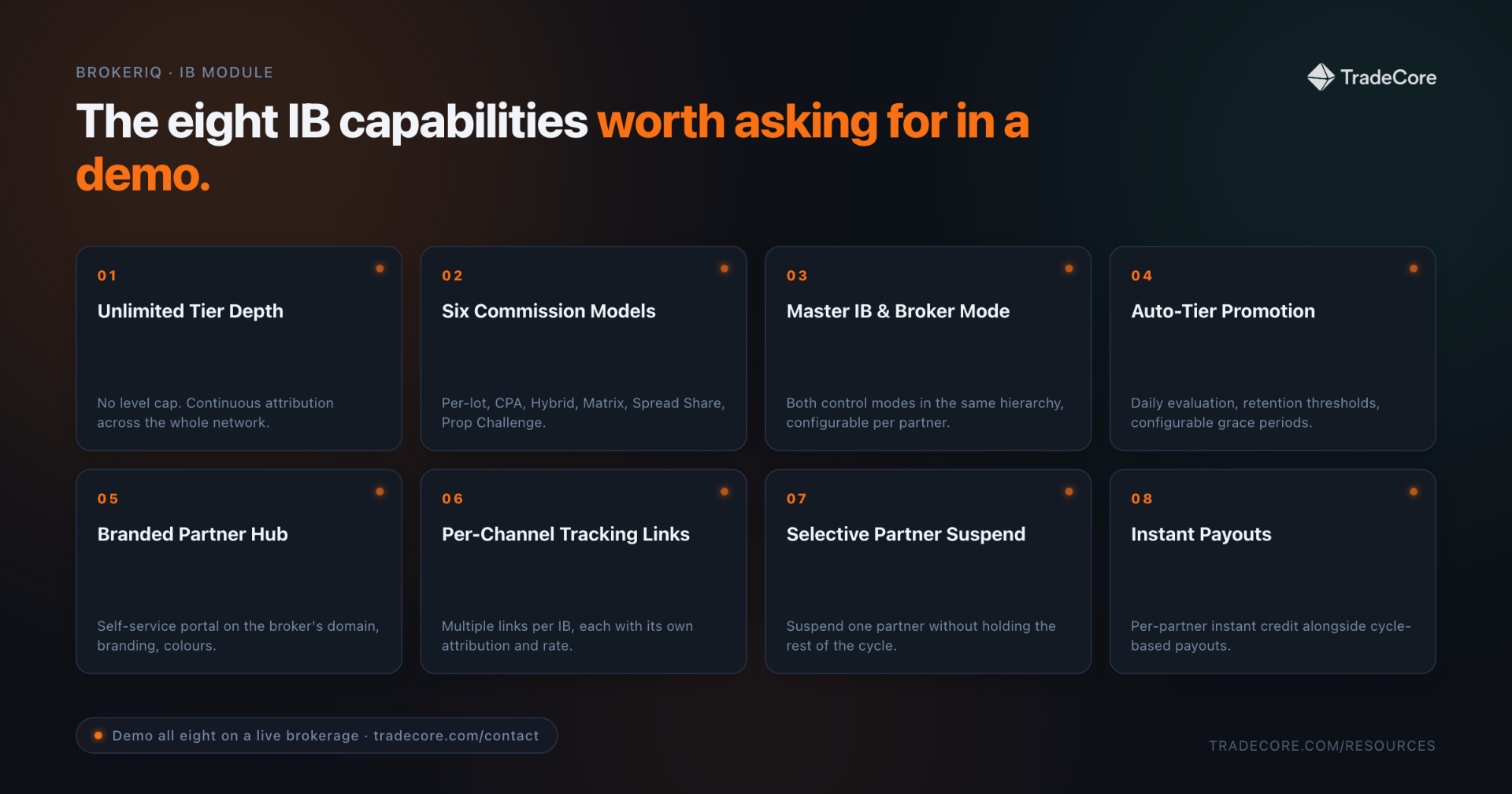
The eight IB capabilities worth asking for in a vendor demo.
See the IB system on a live brokerage
Book a 20-minute demo any week. We walk BrokerIQ's IB module against your real network shape and your actual partner economics, running the same eight questions against a live brokerage.
For a scored vendor comparison on the IB and partner module specifically, see the 2026 forex broker CRM comparison. To see the IB system live, talk to the TradeCore team, or check pricing.
Frequently asked questions
Tags
Ready to Get Started?
Discover how TradeCore can help you build and scale your forex brokerage with our comprehensive CRM.