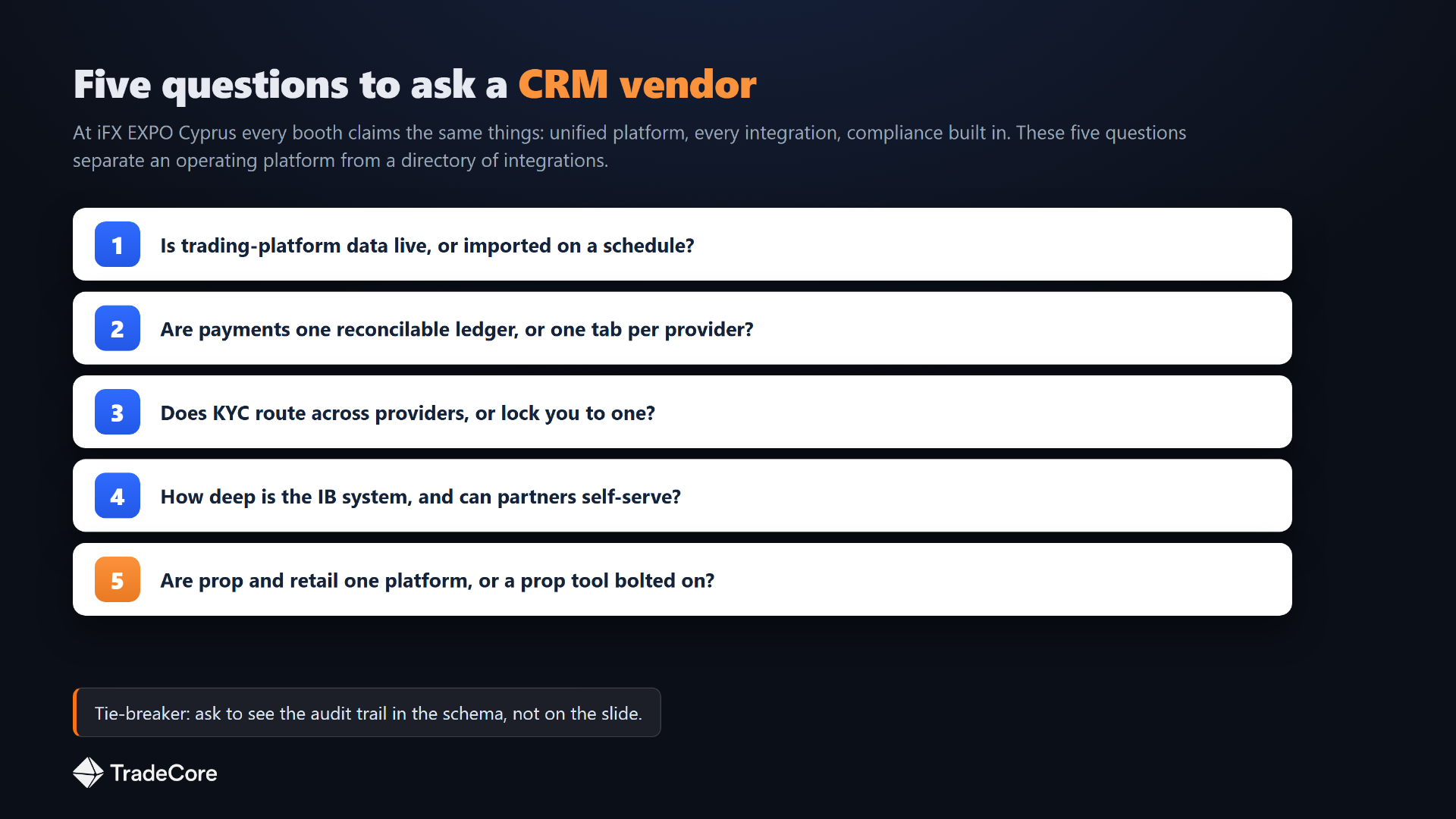
iFX EXPO Cyprus runs from 16 to 18 June in Limassol, and most brokers will walk a floor full of CRM and back-office vendors who all claim the same things. Unified platform. Every integration. Compliance built in. The words are identical from booth to booth. The platforms behind the words are not.
A demo is built to look good. It cannot tell a broker whether the system holds up in the third month, when a payment fails mid-callback or a regulator asks who approved a withdrawal. A booth conversation can do one thing well: separate the vendors selling a directory of integrations from the vendors selling an operating platform. That separation comes from specific questions, not the pitch.
Below are five questions worth asking any forex CRM vendor on the floor. Each comes with the good answer, the weak answer, and where TradeCore stands. They are ordered by impact, the ones that expose the most about a platform first.
Coming to iFX EXPO Cyprus?
We are running these five questions live on a real brokerage at Booth 83 in Limassol, 16 to 18 June. Book a 20-minute slot at tradecore.com/contact or walk up. Full details at the end.
Question 1: Is trading-platform data live, or imported on a schedule?
Every vendor lists the platforms they connect to. The logo wall is not the answer. The follow-up that separates platforms in one sentence is this: when a trade closes, does your system know in real time, or does it find out on the next sync?
The weak answer: the platform polls the trading server every few minutes, or every few hours, and writes the result to its own table. This is technically an integration. It is operationally useless for anything that has to act on a trade as it happens: a first-trade welcome, a risk threshold alert, a commission that pays the moment a lot closes, a prop-challenge rule that fails a trader who breaches a daily-loss limit. On a polled system, all of those fire late, and "late" in compliance and risk is the same as "wrong."
The good answer: the integration streams trade events as they occur, with a scheduled backfill running underneath only to guarantee nothing is missed. The vendor can tell you the transport, not just the platform name.
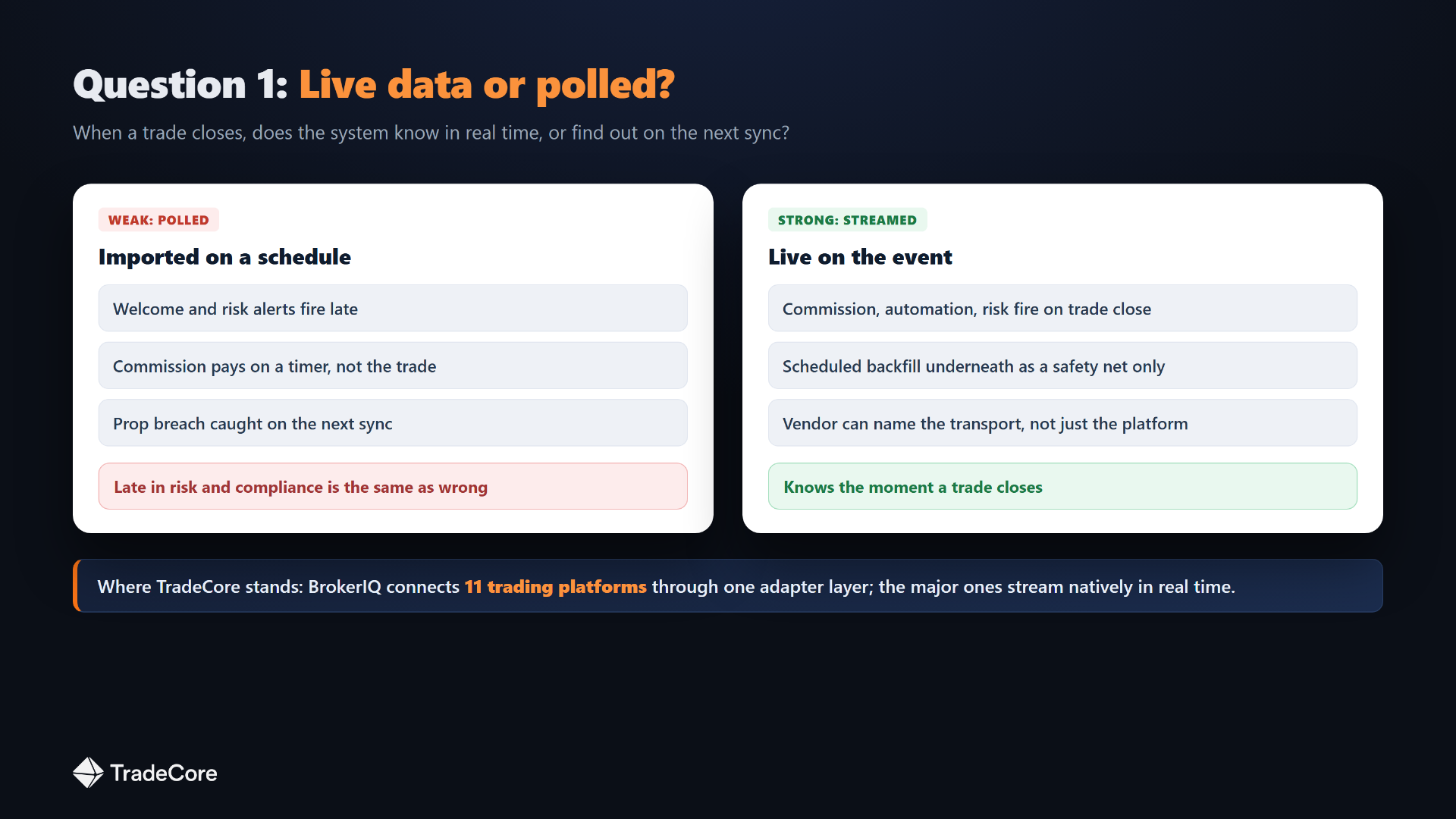
Illustrative diagram comparing live streamed trading-platform data against data imported on a polling schedule.
Where TradeCore stands: BrokerIQ connects to 11 trading platforms through one adapter layer. The major platforms stream natively in real time, with a scheduled backfill running underneath only to guarantee nothing is missed, not as the primary feed. When a trade closes, the commission calculation, the automation rule, and the risk check fire on that event, not on a timer. We walk the exact integration mechanism per platform live at the booth. Count the depth of the connection, not the logos on the slide.
Question 2: Are payments one reconcilable ledger, or one tab per provider?
A broker's payment architecture is one of two things. It is a single ledger across every deposit and withdrawal, or it is a set of links to separate provider dashboards that finance stitches together at month-end. Both look the same in a demo. They stop looking the same the first time a callback fails halfway through, or a withdrawal needs an approval chain, or finance has to answer which provider paid which client this week.
The weak answer: "we connect to your providers and you manage each one in their own dashboard." That is a directory of integrations. The reconciliation work stays with the broker.
The good answer: every provider feeds one ledger, adding a new provider is a configuration change rather than a development sprint, and every withdrawal approval is recorded inside the platform with permanent attribution.
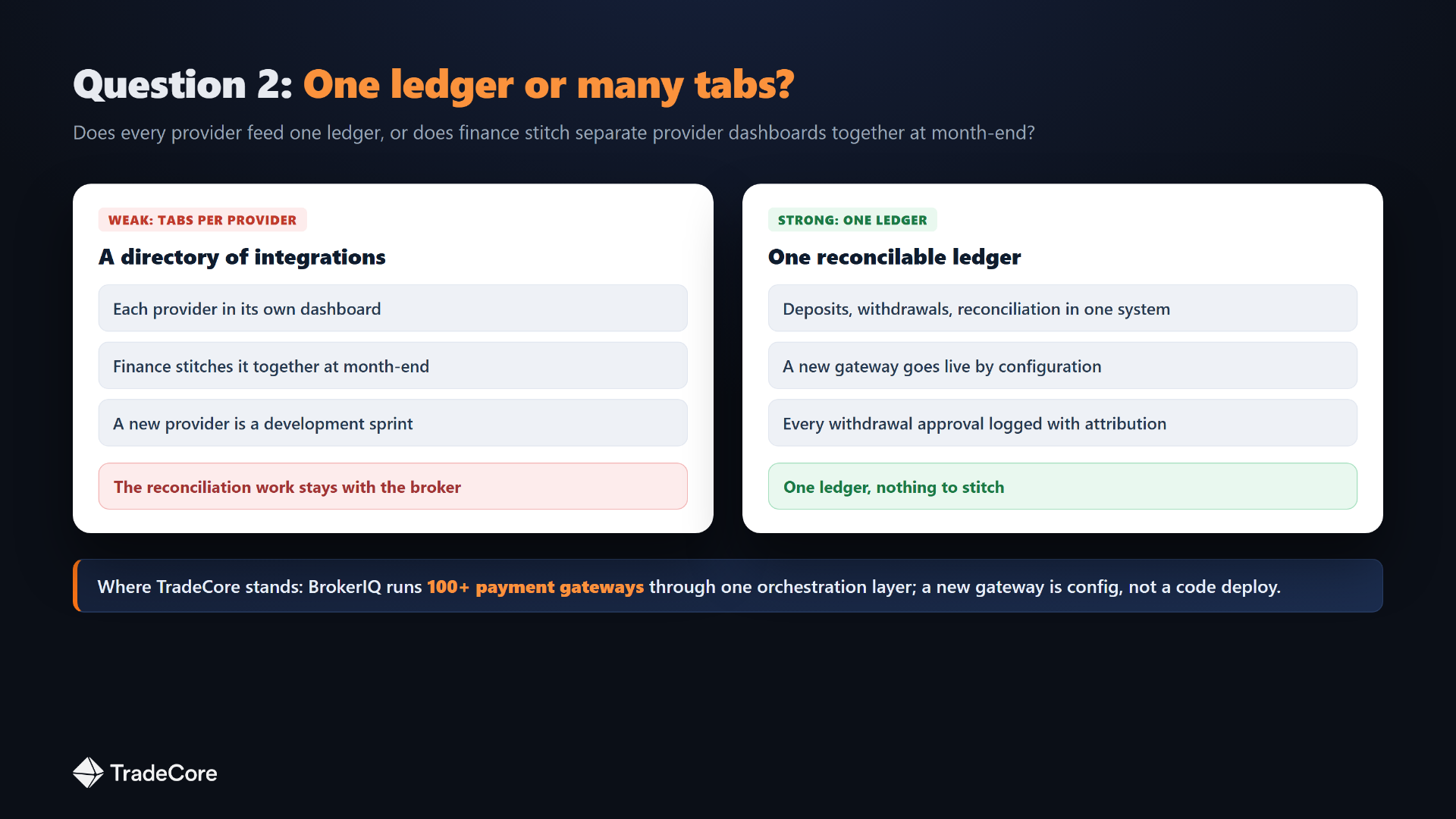
Illustrative diagram comparing one reconcilable payment ledger against separate per-provider dashboard tabs.
Where TradeCore stands: BrokerIQ runs 100+ payment gateways through one orchestration layer with a single adapter pattern. Deposits, withdrawals, card tokenization, fraud scoring, and reconciliation all run through the same system. A new gateway goes live through configuration, not a code deployment. Withdrawals move through a multi-stage approval workflow (Pending, then Authorized, then Accepted or Rejected), and every state change is logged with the user, the timestamp, and the old and new values. There are no separate provider tabs to reconcile, because there is one ledger. Ask it this way: when a callback fails, who reconciles the order, your system or my finance team?
Question 3: Does KYC route across providers, or lock me to one?
Every vendor says yes to "do you support SumSub" and yes to "do you support Onfido." The yes is not the answer. The real question is what the broker does when one provider is wrong for a region, or wrong for a risk band, or raises its pricing in a quarter and the broker wants to send some checks elsewhere.
The weak answer: the platform integrates one KYC provider, or integrates several but runs them in isolation with no routing between them. The broker is tied to that provider's roadmap and pricing, with no fallback and no negotiating position.
The good answer: the platform orchestrates several providers, routing decided by country, risk band, or document type, and an operations user can change that routing without an engineering release. Ask which providers are running in production today, not which are on the roadmap.
Where TradeCore stands: BrokerIQ orchestrates 4 KYC providers in production: SumSub, Onfido, Cellbunq, and GBG. ComplyAdvantage runs underneath as an AML watchlist for sanctions and PEP screening. Each provider runs as a gateway in one validation framework. Gateways fire automatically during signup or are triggered manually from the back office, and provider results map into the user's verification state through configurable rules, not hard-coded logic. No single provider owns the pipeline, so the broker keeps a fallback and a negotiating position.
Note 1: the orchestration is what matters here, not the provider count. A platform with one provider has nothing to route.
Question 4: How deep is the IB system, and can partners self-serve?
Most brokerages grow through introducing brokers and affiliates, so the partner module is rarely a side feature. It is a product. The questions that expose its depth are about tier depth, commission models, and self-service.
The weak answer: the IB hierarchy caps at three or five levels, the platform supports one or two commission models, and there is no partner-facing portal (or the portal is branded by the vendor, so partners log into someone else's domain to see their commissions). Every commission question becomes a support ticket for the broker's operations team.
The good answer: unlimited tier depth, several commission models that can run side by side, and a self-service portal branded to the broker where partners manage their own links, see their own network, and request their own withdrawals.
Where TradeCore stands: BrokerIQ has no cap on IB tier depth. A Master IB can have sub-IBs, those sub-IBs can have their own sub-IBs, and the system tracks attribution and pays at every level. The commission engine runs per-lot, CPA, prop-challenge, and matrix models side by side, and a single partner can combine them. The Partner Hub is the partner-side portal, branded to the broker with the broker's own domain. From it, a partner sees earnings and active clients, browses referred clients, manages their own tracking links, views their full network tree, downloads marketing materials, and requests withdrawals. Every one of those is a ticket the broker's operations team no longer answers. Ask for the maximum tier depth in writing, and ask whether the partner portal carries the broker's domain or the vendor's.
Question 5: Are prop and retail one platform, or a prop tool bolted on?
Prop trading moved from an adjacent category to a line item on most multi-asset brokers' agendas over the last year. The question is whether the vendor runs prop as a first-class product on the same platform as the retail brokerage, or integrates a separate prop tool beside it.
The weak answer: prop is a separate platform connected by an integration. That recreates the exact problem unified back-office software exists to remove: two client databases, two payment ledgers, two audit trails, and a finance team reconciling between them.
The good answer: the challenge engine, the real-time rule enforcement, the funded-account scaling, and the profit-share payouts all live on the same data as the retail clients. One platform, one ledger, one audit trail.
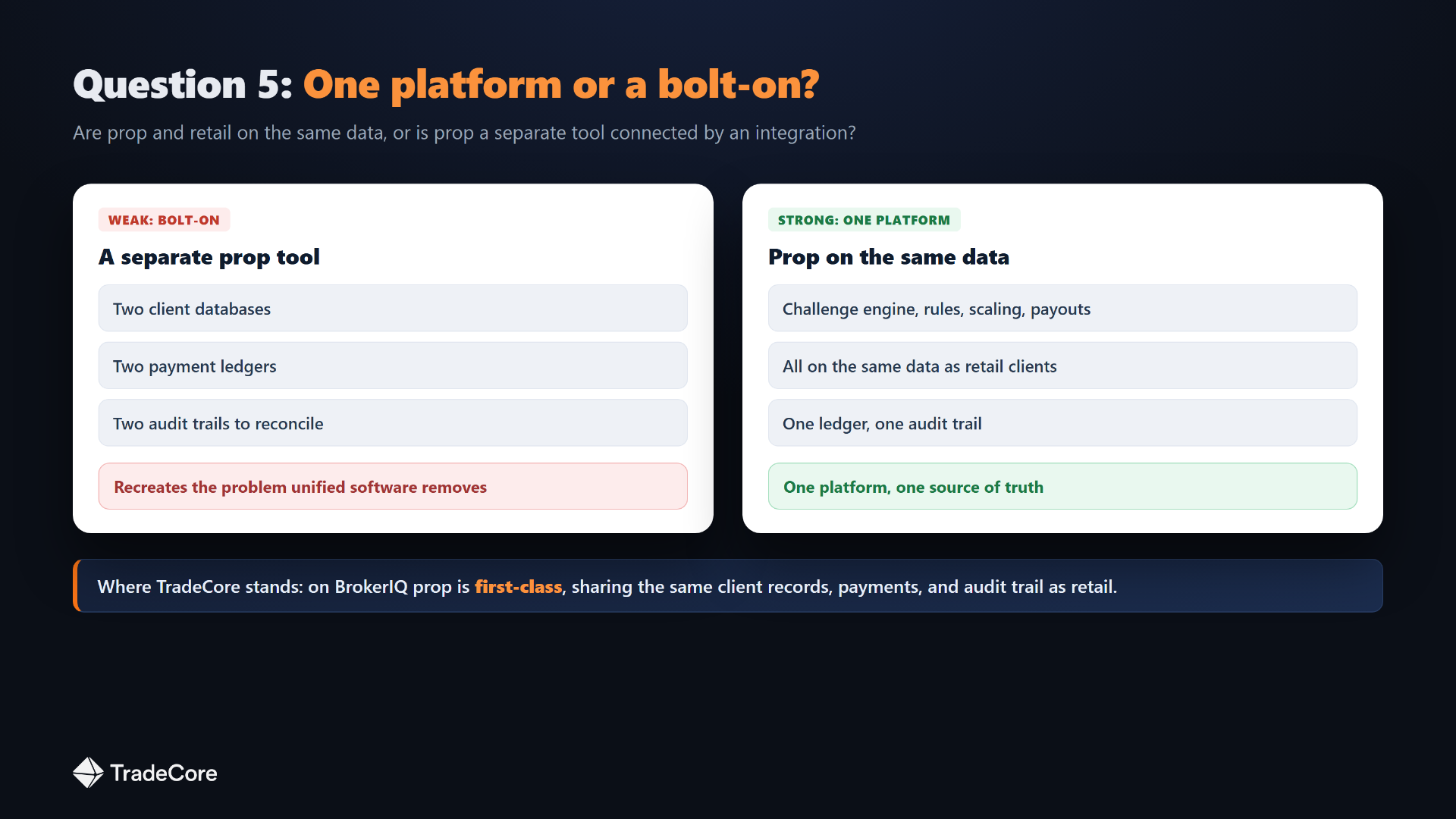
Illustrative diagram comparing prop trading and retail on one platform against a prop tool bolted on beside the brokerage.
Where TradeCore stands: prop is a first-class product on BrokerIQ, not a bolt-on. Brokers configure multi-phase challenges (1-step, 2-step, 3-step, and instant funding) with per-phase trading rules: profit target, daily-loss limit, total drawdown, minimum trading days, time limit, and a consistency rule. The violation checker runs on every trade import on the same real-time feed as Question 1, so a breach is caught when it happens, with an ops review workflow so it can be applied or overridden rather than auto-failing every time. Funded accounts scale through configurable tiers, and profit-share payouts split automatically between trader and firm. All of it shares the same client records, payments, and audit trail as the retail side. Ask the vendor directly whether prop and retail are one platform or two.
The tie-breaker: ask to see the audit trail in the schema, not the slide
When the five answers are close, one question decides it. Ask the vendor to show a customer record, an action on it (a withdrawal approval, a KYC state change, a manual bonus), and the audit entry that captures who did it, when, and what changed. Ask them to show it in the demo environment, on screen.
If they can show it, the audit layer is real. If they pivot to talking about reporting and exports, the audit layer is something the broker would assemble themselves after the fact. The difference does not show in a polished dashboard. It shows the day a regulator asks for evidence.
On BrokerIQ, every state change across payments, compliance, IB payouts, and prop is logged with the user, the timestamp, and the before-and-after values, in an immutable record. That is the answer to ask every vendor to demonstrate, because it is the one a clean demo hides.
What to bring to the floor
Three things make any vendor's answers concrete: a list of the trading platforms you run now, a list of the payment providers you settle through, and one line describing the audit event that causes you the most operational pain today. With those on the table, the conversation moves from what a vendor offers to what it would do for your operation. The right vendor welcomes that. The wrong vendor changes the subject.
Meet us at iFX EXPO Cyprus, 16 to 18 June 2026
We are at iFX EXPO International Cyprus from 16 to 18 June in Limassol at Booth 83, ready to take all five questions live on a real brokerage, plus the audit-trail tie-breaker. Two ways to do it:
- Book a 20-minute window now at tradecore.com/contact so we hold time for you and walk the platform against your real operation, or
- Walk up at the booth during the event. Same questions, same depth.
If iFX is not in your calendar, book a 20-minute demo any week. We run the same five questions against your stack.
For a scored vendor comparison across the full platform, see the 2026 forex broker CRM comparison. To see the platform live, talk to the TradeCore team, or check pricing.
Tags
Ready to Get Started?
Discover how TradeCore can help you build and scale your forex brokerage with our comprehensive CRM.